


When you use our Northwest Territories income tax calculator, it breaks down your finances into several key figures, including your total combined tax, Canada Pension Plan and Employment Insurance premiums, income tax, after-tax income, marginal tax rate, and average tax rate.
The calculator produces those figures by following a structured process. It begins with your gross annual income, subtracts various deductions, finds your taxable income, and then uses the current federal and Northwest Territories tax rates to figure out how much tax you owe.
This process can be explained in five steps, along with answers to common questions about NWT-specific tax rules, as follows.
How to Interpret Your Results in Our NWT Income Tax Calculator
Our NWT income tax calculator takes your total income and deductions, applies the current federal and territorial tax rates, and provides an approximate estimate of your tax liability. Once you submit your required and optional inputs, the calculator will display several output lines, including total tax, CPP and EI premiums, after-tax income, marginal tax rate, and average tax rate. Each of these components serves a specific purpose.
What each term means is explained below:
- Total Tax: This is your combined federal and territorial income tax for the year.
- CPP and EI Premiums: These are mandatory payroll contributions, shown separately from income tax.
- Marginal Tax Rate: This is the rate applied to your highest dollar of income.
- Average Tax Rate: This is calculated by dividing your total tax by your total income, expressed as a percentage.
- After-tax Income: This represents your gross income minus all taxes and premiums.
Note that these figures are approximate because your actual tax liability may vary based on additional credits, deductions, and individual circumstances that simple calculators do not account for. Our calculator does not fully account for separate Northwest Territories benefits or refundable measures that may affect a household’s after-tax income beyond the regular paycheque.
How this Calculator Find Your Income Tax in the Northwest Territories
Your NWT income tax calculation runs in 4 steps: start with your gross income, subtract your deductions, determine taxable income, and apply federal and NWT territorial tax brackets to find your income tax. The calculator then uses this information to estimate your annual net income.
Here is a step-by-step guide for checking income tax in your paycheck:
Step 1: Determine the annual income
To calculate your net salary in the Northwest Territories, start with your gross annual income. This is done by multiplying your per-period employment income by the number of pay periods in a year.
Step 2: Determine deductions
Next, you need to account for your deductions. EI premiums are 1.63% of your income, with a maximum contribution of $1,123.07. CPP contributions are set at 5.95% on income above $3,500, with a maximum of $4,230.45. Additionally, if your income falls between $74,600 and $85,000, you will also owe CPP2 contributions at a rate of 4%, with a maximum of $416.
Step 3: Determine taxable income
To arrive at your taxable income, start with your gross income and add any other annual income, vacation pay, bonuses, and other employment earnings from your T4 slip. Other employment income is recorded on line 10400, and your total income goes on line 15000. Then, subtract your eligible deductions and the CPP additional contribution (which is your taxable income multiplied by 0.0100).
Step 4: Determine income tax
Calculate your income tax by determining both the federal and provincial tax rates in the NWT.
To calculate your federal income tax for 2026, use these brackets on your taxable income:
- 14% on the first $58,523
- 20.5% from $58,523 to $117,045
- 26% from $117,045 to $181,440
- 29% from $181,440 to $258,482
- 33% on income above $258,482
To compute your federal tax liability, reduce the basic federal tax by credits derived from the FBPA, ranging from $14,829 to $16,452, your CPP contributions, your EI premiums, and the Canada Employment Amount.
For the NWT territorial tax, use these brackets:
- 5.9% on the first $53,003
- 8.6% from $53,003 to $106,009
- 12.2% from $106,009 to $172,346
- 14.05% on income above $172,346
You can reduce your territorial tax using credits from the basic personal amount, CPP contributions, and EI premiums.
To find your net income for the year, add your EI premiums, CPP contributions, federal tax, and territorial tax together, then subtract that total from your gross annual income. Divide the result by your number of pay periods to arrive at your take-home pay per period.
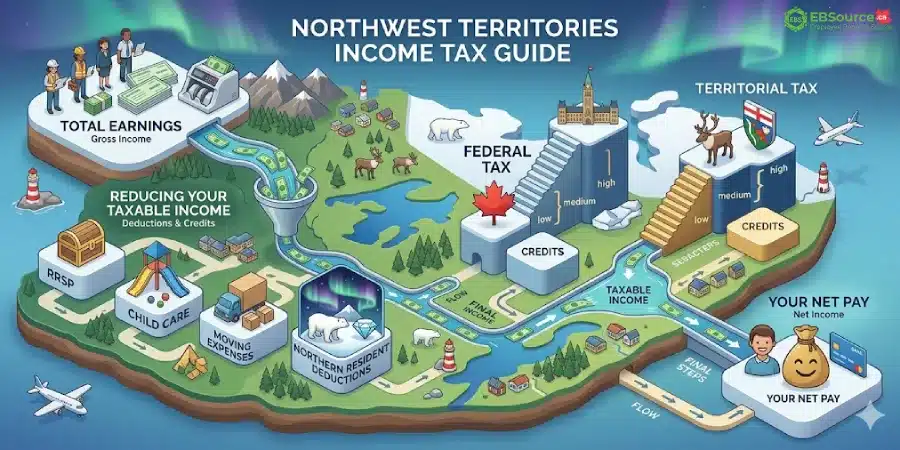
How Federal and Territorial Income Taxes in NWT Layer Together
If you live in the Northwest Territories, your income tax bill comes from two separate sources: the federal government and the territorial government. Both levels independently use the same taxable income figure from your return, but each applies its own set of progressive brackets and rates. Your total income tax for the year is simply the combined result of these two calculations added together.
To see how this works in practice, consider a single NWT resident with a taxable income of $90,000 in 2026 and no credits beyond the basic personal amounts. The federal tax applies a rate of 14% to the first $58,523 and 20.5% to the remaining amount. This results in approximately $11,252 in federal tax after accounting for the basic personal amount credit.
The territorial calculation follows the same logic but uses the NWT’s own brackets. The NWT tax applies a rate of 5.9% to the first $53,003 and 8.6% to the remaining, leading to an approximate territorial tax of $4,864 after considering the NWT basic personal amount credit. Therefore, the combined income tax for this resident totals roughly $16,116.
Comparison of NWT Income Tax and After-tax Income with Other Provinces/Territories
Understanding how these two layers of tax interact is especially useful for evaluating the NWT’s overall tax burden compared to other provinces and territories in Canada. The following sections will examine this from two perspectives. First, we will compare the NWT’s combined federal-territorial tax rates to those of other regions across Canada. Then, we will focus on what residents actually retain by examining after-tax income in the NWT, given the absence of a territorial sales tax and the realities of living costs in the North.
Here are the two perspectives that you should know when calculating federal and territorial income taxes:
How Northwest Territories Income Tax Compares to Other Provinces/Territories
The Northwest Territories has income tax rates ranging from 5.9% to 14.05%, resulting in a combined federal-territorial tax rate of 20.9% to 47.05%. This is lower than that of many other regions in Canada.
For comparison, Nova Scotia has a combined top rate exceeding 54%, while Quebec’s rate is above 53%. Nunavut has the lowest rate at 4%, while the NWT’s starts at 5.9%, placing it in the middle among the territories for the lowest tax bracket. Overall, the NWT has competitive tax rates compared to the rest of Canada. In contrast, Alberta has a flat 10% tax rate and no sales tax, while Quebec has the highest provincial tax rates in the country.
How the Northwest Territories’ After-tax Income Compares to Other Provinces/Territories
Due to competitive territorial tax rates across all income brackets, residents of the Northwest Territories generally retain more after-tax income than those in most provinces. Another significant advantage for NWT residents is the absence of a territorial sales tax. They only pay the 5% federal Goods and Services Tax (GST) on goods and services. In contrast, provinces with harmonized sales tax rates of 13% to 15% impose a much higher consumption tax on everyday purchases, further widening the overall tax burden.
However, these tax savings are often balanced out by the high prices of goods, services, and housing in remote northern areas. Things like groceries, energy, and transportation can cost much more in the NWT than in southern cities. While the Northern Residents Deduction helps cover some of these extra costs, people in the NWT should consider both the tax savings and the higher living expenses when assessing their overall financial situation after taxes.
FAQs about the Northwest Territories income tax calculator
Does the NWT have a sales tax that impacts income tax calculations?
No. Unlike provinces that impose their own sales taxes, the NWT does not have a territorial sales tax. Instead, it adheres to the federal Goods and Services Tax (GST) system.
Does the NWT offer a child benefit that lowers a family’s taxes?
Yes. The Northwest Territories offers the Northwest Territories Child Benefit, which is a non-taxable monthly payment. However, it is not a typical payroll tax reduction included in our calculator. While it can increase a family’s overall after-tax income, it does not function as a direct deduction from each paycheck.
How does a non-resident earning income from the NWT calculate their territorial tax?
Non-residents of Canada who earned employment income solely in the Northwest Territories, or who received income from a business with a permanent establishment only in the NWT, must also complete Form NT428 to calculate their territorial taxes.
Disclaimer: Our NWT income tax calculator is intended for general informational purposes only and provides estimates of payroll deductions based on employment income. It is not a substitute for the CRA payroll tools or a complete personal income tax return calculation.
